My career has been a synthesis of art and technology, starting with a degree in art with a concentration in sculpture and performance art. After graduating in 1972, I moved to Los Angeles to attend CalArts for a year.
My entry into film came through a series of unplanned opportunities. I was perpetually looking for work to support my performance art. Fortunately, the USA still had the EEOC (Equal Employment Opportunity Commission), which mandated that businesses could no longer be all white and male. The Hollywood trade unions were told to diversify their membership; the catch was that before being considered, one had to already be trained. On the Executive Board of the projectionist local was one man, a strong supporter of the underdog, who took it upon himself to train us misfits. He trained me at the theater where he worked, a porn theater on Western just north of Sunset. I learned to change reels, splice film, and maintain the projectors. My time as a projectionist was cut short due to differences between me and the president of the local.
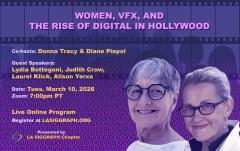
Again, I was searching for work, I put out the word, and a friend, Suzanne Lacy - a well-known performance artist - was living with Rob Blalack, head of the optical department on the film Star Wars. At that time, there was only one Star Wars, and they needed a film cleaner. I was hired for the overnight shift. My job was to thread the film elements that were used in compositing onto rollers inside a cabinet, close the door, and fire it off. The noxious chemicals inside then rid the film of dust. Since it was a film, one speck of dust was not acceptable. It was on that job that I met Donna Tracy. She taught me how to splice film using a splicer that was the size of an old sewing machine with a variety of foot controls.
At the conclusion of Star Wars post-production, I went to work for Blalack at his company, Praxis Film Works. While there, Blalack taught me how to “pull” a blue screen matte shot. Knowing blue screen was a sought-after skill, thus my craft was in demand. Fortunately, I was hired by Gene Warren and Leslie Huntley, the owners of Fantasy II, to work on the mini-series “Winds of War”. Despite the chaos of a family business, it was an exceptional place to work. It was through them that I was able to join the Cinematographers’ local.
In 1985, I moved to New York and went to work for R. Greenberg & Associates. It was at Greenberg’s that I first started working digitally. I was the first to learn how to operate their new digital equipment, mostly with no or very brief manuals. Because I was knowledgeable about both digital and film VFX, I was hired by ILM to come back west and join their nascent digital effects department. At the time, they were using Photoshop for compositing. Relying on my knowledge of film opticals, I developed a procedure to pull a blue screen digitally. Film taught me about color and light, and to be precise, all things that can be transferred to the digital world.
As a freelancer, I worked for many notable companies, including ILM, RGA New York, RGA/LA, Cinesite, and Warner Feature Animation. Along the way, moving from compositor to digital supervisor to visual effects supervisor and becoming a member of the Motion Picture Academy, the Television Academy, and the Visual Effects Society. It was on “Frank Herbert’s Dune” that I won an Emmy in 2000 for Visual Effects Supervision.
Projects I have worked on include “The Terminator”, “The Predator”, and “Altered States “. I have continued to make performance art, showing at Franklin Furnace in New York, Long Beach Museum of Art, and The Bronx Museum.